
This page is about learning basic lesson ,and key words to know in Japanese. I am not fluent speaker but I hope to inspire you in studying Nihongo /Japanese/ while i myself am studying to improve my language skill.
KEY POINTS TO REMEMEBER – At first its exciting to learn the first few communication words in any language ,but after a while its hard to keep going specialy in Japan where people can easily understand you with few key words for communication and then you might feel not urged to study more – thanks to Google translate and other devices which are used to direct translate the language . Therefore You have to clearly have a personal motivation to study.
Why you want to Study Japanese? (Answer this question before you proceed and write it somewhere you always can see or refer to)
Here are my Reasons

1. Learn one new word or statement each day 2.Try to speak in every opportunity you get 3. Try reading the words written in katakana or hiragana everyday before you run to Google translate.
Learn one new word or statement each day, so i like to share this page for today https://www.linguajunkie.com/japanese/simple-japanese-conversation
1. Introducing yourself in Japanese
- John: Hi! Nice to meet you, I’m J! I’m 36 years old, and I’ve lived in Japan for 5 years.
- こんにちは!はじめまして、アキです。わたしは、36歳で、日本には、5年住んでいます。
- Konnichiwa! Hajimemashite John desu. Watashi wa san juu roku sai de nihon ni wa go nen sundeimasu
- Somo: Hi John, nice to meet you I’m Somo. I’ve lived in Japan for a year, and 5 years in Italy.
- こんにちは、アキ。わたしは、トモです。日本には、1年間住み、イタリアには、5年間住んでいました。
- Konnichiwa Aki. Watashi wa Tomo desu. Nihon ni wa ichi nenkan sumi itariya ni wa go nenkan sundeimashita
- John: Italy, sounds exciting!
- イタリアは、楽しそうですね!
- Itariya wa tanoshisou desune
Here are some important words and phrases from this simple Japanese conversation. You’ll need these for introducing yourself in Japanese.
- Konnichiwa – Hello
- Hajimemashite – Nice to meet you- use only once
- Watashi wa (name) desu – I am (name).
- Watashi wa (#)sai desu. I am (#) years old.
2. Asking someone if they are free to hangout
schedule.
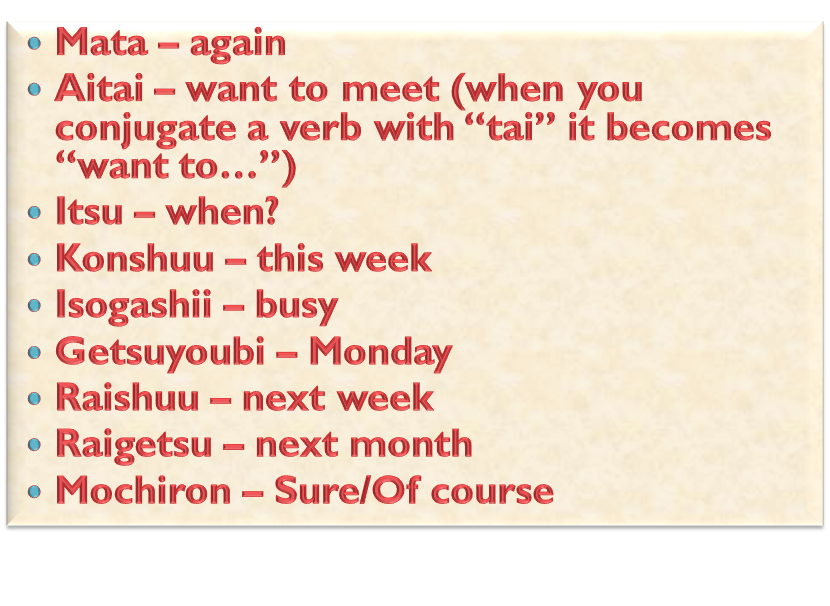
- A: I’d like to see you again. When are you free?
- また、会いたいです。いつ空いてますか
- Mata aitai desu. Itsu aitemasuka
- N: I’m pretty busy this week. How about next Monday?
- 今週は、結構忙しいです。来週の月曜日は、どうですか。
- Konshuu wa kekkou isogashii desu. Raishuu no getsuyoubi wa doudesuka
- Aki: I’m not free next week. Just let me know when you are free next month.
- 来週は、空いていません。来月に空いたら教えてください。
- Raishuu wa aitemasen. Raigetsu ni aitara oshiete kudasai
- Tomo: Sure, I’ll send you an e-mail. See you soon!
- もちろん。メールを送ります。では、また会いましょう!
- Mochiron. Meeru wo okurimasu. Dewa mata aimashou
Let’s take a look at some words from this simple Japanese conversation:
3. Ask someone their age
It may be a touchy subject for some, but sometimes it’s necessary to ask someone their age.
You can also learn ways to say it in the most polite way possible.
- Aki: Tomo, it looks like our hobbies are very similar. If you don’t mind me asking, how old are you?
- トモさん、私たちの趣味がとても似ているようですね。もし、差し支えなければ、いくつですか。
- Tomo san watashitachi no shumi ga totemo niteiruyoudesune. Moshi sashisasae nakereba ikutsu desuka
- Tomo: I am 35 years old. How about you?
- 私は、35歳です。アキさんは、いくつですか。
- Watashi wa san juu go sai desu. Aki san wa ikutsu desuka
- Aki: I’m 35, too! Wow! So we are from the same generation!
- 私も35歳です。すごい!一緒の世代なんですね!
- Watashi mo san juu go sai desu. Sugoi! Issho no sedai nandesune!
Remember. Asking “ikutsu desu ka?” is a very polite way of asking for the age. You will hear this often. But, you will also hear “nansai desu ka” which is more casual and literally means “what age?”
To talk about your age in Japanese, you’ll need to learn Japanese numbers.
4. Ask someone if they speak English
If you want to take your simple Japanese conversation further, you might want to speak in English.
It doesn’t hurt to ask if they speak English!
- Aki: If it’s okay with you, can I speak in English?
- もしよろしければ、英語で話してもいいですか。
- Moshi yoroshikereba eigo de hanashitemo iidesuka
- Tomo: Sure, no problem. I need to practice my English, too. How long have you been studying English for?
- もちろん、問題ありません。私も英語を練習しなければいけません。英語は、どれくらい長く勉強してますか。
- Mochiron mondai arimasen. Watashi mo eigo wo renshuu shinakereba ikemasen. Eigo wa doregurai nagaku bennkyou shitemasuka
- Aki: I’ve been studying English for about 2 years now. But it is still hard for me to converse.
- 英語は、2年ぐらい勉強しています。でも、まだ話すのが大変です。
- Eigo wa ni nen gurai benykou shiteimasu. Demo mada hanasu no ga taihen desu
Words:
- Eigo – English
- Mondai – Problem
- Hanasu – to speak (verb)
- Benkyou – study
- Demo – but
- Taihen – tough
5. Ask for directions
Ahh, this is one of the most useful phrases anywhere you go. So, don’t forget to remember it.
Your Japanese conversation can go like this:
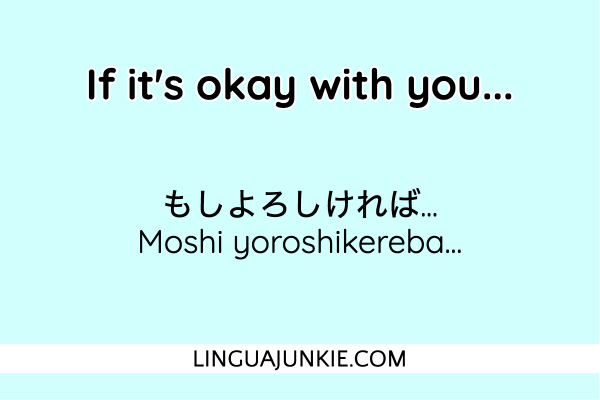
- Aki: Excuse Me. Do you have a moment?
- すいません。ちょっと時間ありますか。
- Suimasen. Chotto jikan arimasuka.
- Tomo: Yes, sure what’s up? Are you lost?
- はい、いいですよ。迷っているのですか。
- Hai, iidesuyo. Mayotteiruno desuka
- Aki: Yes, I am lost. Can you tell me where Takashimaya is?
- はい、ちょっと迷っています。タカシマヤがどこにあるか、教えてもらえますか。
- Hai, chotto mayotteimasu. Takashimaya ga doko ni aruka oshiete moraemasuka
- Tomo: If you go straight here, you can turn right at the first stoplight. Then, you will see it on your left side.
- ここをまっすぐ行くと、最初の信号で右に曲がってください。左側にあります。
- Koko wo massugu iku to saisho no shingou de migi ni magattekudasai. Hidari gawa ni arimasu
Some words from this simple Japanese conversation:
- Suimasen – casual way of saying “excuse me”
- the proper way, with proper spelling and all, is sumimasen
- Chotto – a little
- Jikan – Time
- ii – good
- Doko – where
- Massugu – straight
- Saisho – first
- Shingou – stop light
- Migi – right
- Hidari – Left
Now, what’s the BEST way to master these basic Japanese conversations?
- Print this page out.
- Put it in your notebook.
- And, every now and then read through it.
Here are some more Japanese conversation script and dialogues.
6. Talking about your routine in Japanese
This Japanese conversation dialogue is about a gym-going Jon and his coworker, Tanaka. Basically, they’re just talking about a daily routine.
But, here, the Japanese comes first and the translations come after. Cool?
- Tanaka: ジョンさん、いつもいっぱい食べますね。
- Jon-san, itsumo ippai tabemasune.
- Jon, you always eat a lot, huh.
- Jon: 毎日、午前中、おなかがペコペコです。
- Mainichi, gozenchuu, onaka ga pekopekodesu.
- I get hungry every day in the morning.
- Tanaka: 朝ごはんは、毎日食べますか。
- Asagohan wa, mainichi tabemasu ka?
- Do you eat breakfast everyday?
- Jon: はい、食べます。そして、ジムに行きます。それから、会社に行きます。
- Hai, tabemasu. Soshite, jimu ni ikimasu. Sorekara, kaisha ni ikimasu.
- Yes, I do eat. I also go to the gym. After that, I go to work (company).
- Tanaka: へぇ、毎日ですか。すごいですね。
- Hee, mainichi desu ka? Sugoi desu ne.
- Wow, every day? That’s incredible.
- Jon: たなかさんは、うんどうしますか。
- Tanakasan wa, undou shimasuka?
- What about you, Tanaka? Do you work out?
- Tanaka: わたしは、ときどき、プールに行きます。
- Watashi wa tokidoki puur ni ikimasu.
- I go to the pool sometimes.
7. Students Getting to Know Each Other
This is a fairly common Japanese conversation script. These types of conversations happen all the time. Take a look.
- Student 1: 学生ですか。
- Gakusei desu ka?
- Are you a student?
- Student 2: はい。月大学(つきだいがく)の留学生です。
- Hai, tsuki daigaku no ryuugakusei desu.
- Yes, I’m a study abroad student at “tsuki” university.
- Student 1: うそ?月大(つきだい)?私も 月大(つきだい)の 学生です。
- Uso? Tsukidai? Watashi mo tsukidai no gakusei desu.
- No way! Tsuki? I’m also a student at Tsuki University.
- Student 2: 本当?何年生ですか。
- Hontou? Nannensei desu ka?
- Really? What year are you?
- Student 1: 二年生です。専攻は英語学です。
- I’m a sophmore (lit. 2nd year). My major is English.
8. Drinking in Japanese
This next Japanese conversation dialogue is about getting “smashed” in Japanese. Well, just about buying drinks.
- A: まさとさんは、なにをのみますか。ワインですか?ビールですか。
- Masato san wa, nani wo nomimasu ka? Wain desuka? Biiru desu ka?
- Masato, what will you drink? Wine? Beer?
- Masato: ぼくは、ビールをのみます。
- Boku wa biiru wo nomimasu.
- I’ll drink beer.
- A: じゃ、ビールをかいます。かおりさんは?かおりさんもビールをのみますか?
- Ja, biiru wo kaimasu. Kaori san wa? Kaori san mo biiru wo nomimasu ka?
- Ok, I’ll buy beer. Kaori? Kaori will you drink beer too?
- Kaori: ええ。ちょっと
- Ee, chotto.
- Yeah, a little.
9. Asking about things in Japanese
If you want to know how to ask about things, this Japanese conversation script helps.
- Masato: これはなんですか?
- Kore wa nan desu ka?
- What is it?
- Bob: それはミートローフです。
- Sore wa meetoroofu desu.
- That is meatloaf.
- Masato: ミートローフ・・・?
- Meetoroofu…..?
- Bob: はい。にくです。
- Hai. Niku desu.
- Yes. It’s meat.
10. Where you are from.
This last Japanese conversation script deals with origins.
- Masato: 出身はどこですか。
- Shusshin wa doko desu ka?
- Where are you from? (Lit: Where’s your hometown)
- Bob: アメリカです。
- Amerika desu.
- I’m from America.
- Benito: メキシコです。
- Mekishiko desu.
- I’m from Mexico.
- Bonjour: フランスです。
- Furansu desu.
- I’m from France.
- Bo: ベトナムです。
- Betonamu desu.
- I’m from Vietnam.
Japanese Conversation Practice
Now that you have 10 Japanese conversation scripts, what’s next?
How can you get some good Japanese conversation practice from this?
1) Read out loud and 2) try and speed up your reading. Why?
The faster you can read, the better you’ll get at reading and speaking in general.
Speaking fast Japanese is a sign of expertise. When native speakers notice this, they’ll understand that you’re good “enough” and don’t need to stop and think of every word.
3) Review these Japanese conversations as much as possible. Nobody masters things on the first try. If you want these to be in your head, you need to review them for a few minutes per day.
4) Print this page out. That will make the reviewing easier. And if you want, you can also get the Japanese conversation PDF for practice.
 Ready for ...